
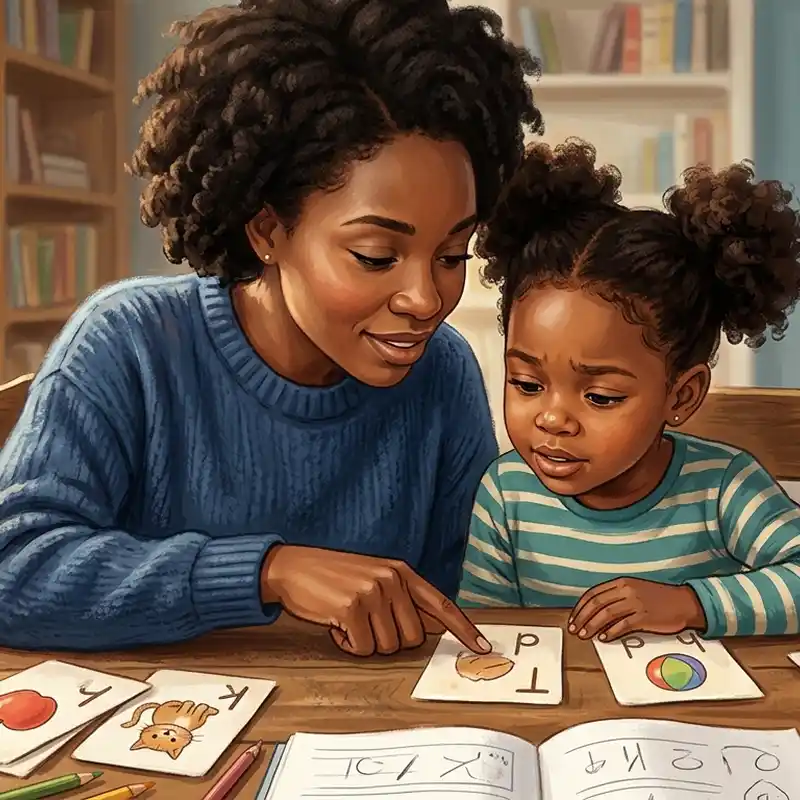
Learning to read is built session by session — so your child works with the same online phonics tutor every time, not a rotating stranger. Sessions follow the exact phonics skills your child's teacher is covering, from sounding out CVC words in kindergarten to blending consonant clusters in 2nd grade. Most families see measurable gains in confidence and decoding within the first few weeks.


Jen is a certified teacher with a bachelor's degree in secondary education who specializes in building confident English speakers. She creates engaging, fun lessons that help elementary students develop strong language skills and a genuine love for reading and writing. Jen believes every student can succeed with the right approach and encourages her learners to speak up with confidence in class and beyond.

Mae Ann has taught students from preschool through high school across a wide range of settings and grade levels, and that breadth shows in how naturally she reads where each child is starting from. A Social Science Education graduate, she builds sessions that feel safe and genuinely encouraging from the very first lesson.

Margilou spent her first career as an accountant before trading spreadsheets for lesson plans — and her analytical background shows in how methodically she structures ESL sessions. Six years in, she's developed a play-based approach that parents consistently praise for keeping young learners genuinely engaged without sacrificing real, measurable progress.

Neidin S. is an English teacher with 13 years of experience specializing in early childhood literacy. She creates fun, engaging lessons using stories, songs, and simple activities to help young learners build confidence in speaking and understanding English. Her patient, friendly approach is tailored to each child's individual learning pace, making reading and language arts enjoyable for PreK and early elementary students.

Rani Maria G. is a passionate educator specializing in early literacy and phonics for young learners in PreK through Grade 5. She creates warm, engaging classrooms where children build confidence through interactive, activity-based learning tailored to each student's pace. With a focus on communication skills and independent thinking, Rani helps early readers develop strong foundations while nurturing curiosity and a love of learning.

Sarah is a passionate English tutor specializing in early literacy for PreK through 5th grade. She brings a fun, engaging approach to learning, carefully adjusting her teaching pace to match each child's needs and learning style. Sarah believes that reading and writing should be exciting adventures, and she creates personalized lessons that help young learners build confidence and a genuine love for language.

Shifau is a dedicated educator specializing in elementary English and Math for grades K-5. With training in classroom management, inclusive education, and 21st-century teaching strategies, she creates engaging, student-centered lessons that build confidence and improve academic performance. Her TEFL certification and experience with learners ages 8-14 enable her to adapt instruction to each student's needs and learning style.

Zeba K. is a dedicated English tutor with over a decade of experience teaching elementary students in both classroom and online settings. She specializes in phonics and foundational language skills, with a proven ability to build student confidence and adapt lessons to different learning styles. Zeba focuses on helping young learners develop strong reading and writing foundations through clear, engaging instruction.
Grades K through 2 cover the most critical window in a child's reading development — the shift from learning to read to reading to learn. By the end of second grade, students are expected to decode two-syllable words fluently, recognize common vowel teams, and read at a pace that supports comprehension. A gap at any point in this sequence compounds quickly.
Second grade is where phonics gaps become visible to parents for the first time. A child who made it through first grade by memorizing high-frequency words hits a wall when the words get longer. The core demand at this level is syllable division.
Phonics doesn't get harder from K to 2 — it gets more layered. Every new pattern assumes the previous one is automatic, and most classroom instruction moves on before that automaticity is confirmed.
This is the foundational phonics error, and it survives well past kindergarten. The child has heard "this letter is called bee" hundreds of times and has mentally bundled the name with the sound. When asked what sound the letter makes, they say "bee" — because that is what they know the letter to be. On a test, shown the word bat, they say "bee-ay-tee" or attempt a word starting with "B" rather than blending /b/-/æ/-/t/. The National Reading Panel Report (2000) identified letter-sound knowledge — distinct from letter-name knowledge — as one of five essential pillars of reading instruction, and noted explicitly that letter-name fluency does not predict reading success on its own.
Shubhra, one of our phonics tutors, notes that students at this stage rarely show any sign of the gap during structured activities — they perform confidently with alphabet books and choral exercises. In a recent session with a Grade 1 student, Shubhra removed the visual context and asked the student to produce sounds for randomly ordered letter cards. The student named every letter correctly but produced the sound for only about half. The intervention was sound-first flashcard drilling in random order, producing only the phoneme — never the letter name — until responses came in under a second.
If your child can sing the alphabet perfectly but says "bee" when you point to the letter B and ask "what sound does this make?", this is almost certainly the active gap.
Once a child has drilled CVC words, the one-letter-one-sound rule is firmly installed. Digraphs violate it. When they see ship, they try /s/-/h/-/i/-/p/. When they try to spell ship, they write "sip" or "sehip." When they see that, they produce "tuh-huh-at." The error shows up in multiple forms: reading errors on words with sh, ch, th, or ck; spelling errors that omit the second letter of the pair; and reading pace that slows sharply the moment a digraph appears mid-sentence. Linnea Ehri's research on the consolidated alphabetic phase (Scientific Studies of Reading, 2005) established that fluent decoding requires children to chunk letter patterns, not process letter-by-letter — and that this chunking must be explicitly taught, not picked up implicitly.
One of our tutors documented this clearly with a Grade 2 student earlier this year. The student read single-syllable CVC words without hesitation, then stalled on every digraph word in the same passage. The session notes describe "the shift to independent rhyme production" as a breakthrough — moving from single sounds to sound families unlocked digraph recognition within the same session once the physical curve-and-mark technique was introduced.
If your child reads cat and sit easily but sounds out each letter separately on words like ship, that, chip, this is almost certainly the active gap. The fix is explicit: the tutor has the child draw a curve under the digraph letters to visually bind them into one sound, then reads with that cue, then fades the marker as automaticity builds.
By second grade, the students who haven't learned syllable division treat every word the same way they treated cat: start at the left, produce a sound for each letter, hope for the best. Shown picnic, they say "pih-kuh-nih-kuh" — or they guess "pickle" from the opening p-i-c. Mrinnmoyee, one of our Grade 2 tutors, recommends short daily home practice sessions specifically because this gap is one of automaticity, not concept understanding. In sessions this year, Mrinnmoyee observed students who could correctly explain that words have syllables but still read two-syllable words as a single unbroken chunk under timed conditions — the strategy existed; the habit didn't.
If your child can decode one-syllable words accurately but reads two-syllable words slowly or guesses from the first few letters, this is almost certainly the active gap. The pedagogical fix is to teach one explicit syllable-division rule at a time — starting with closed syllables (consonant-vowel-consonant = short vowel) — and have the student physically mark the syllable break before reading, then read chunk by chunk.
All three of these are diagnosable in a single session with the right online phonics tutor, and addressable in a handful of focused sessions — not a semester of re-teaching.

Phonics tutors on Ruvimo work across the full K–2 range — CVC words, digraphs, CVCe patterns, vowel teams, and two-syllable decoding. They know where the curriculum transitions get rocky and which gaps look like reading problems but are actually phonics problems. Sessions are live and 1-on-1, so your child's specific error pattern gets addressed directly, not covered over.

Before the first session, our AI diagnostic identifies where your child's phonics sequence broke down — whether that's letter-sound automaticity, digraph recognition, or syllable division. These are three distinct gaps that each require a different approach, and confusing them is what makes home practice frustrating. The first session starts at the right place.

Phonics instruction only works when it builds on what the student actually knows. A tutor who has worked with your child for four sessions knows which letter-sound correspondences are automatic, which patterns need one more round of practice, and exactly where the next unit will cause trouble. That continuity is what turns sessions into steady progress.

Sessions follow the CCSS Reading Foundational Skills sequence (RF.K through RF.2) and align to the phonics scope and sequence used in major programs including Fundations, Heggerty, and Journeys. If your child's school uses a specific decodable reader series or benchmark assessment like DIBELS or iReady, the tutor works within that same framework.
Try our online tutoring risk-free!
ZERO cost, NO credit card details required. Cancel anytime
Book your first 1-hour session NOW!
Book a free 60-minute trial session at Ruvimo.com — no credit card required. The AI diagnostic runs before the session to identify your child's specific gap, the tutor arrives prepared to address it, and you'll receive a written summary after. If it's a fit, sessions are $25–$30 each with no contracts.
Classroom phonics instruction moves at the pace of the group. Most programs introduce a new pattern every week or two and assess at the end of a unit — by which point a child who didn't fully automate the previous pattern is already behind the new one. A 1-on-1 session can spend the full time on the specific pattern your child hasn't locked in yet, without moving on until it's actually automatic. That's the gap classroom instruction can't close on its own.
Before each session, Ruvimo's AI generates a lesson plan for the tutor based on where your child currently is in the phonics sequence. After the session, the AI produces a progress summary sent directly to you — what was covered, what clicked, what needs more repetition, and what the next session will focus on. You don't have to chase the tutor for an update; it arrives automatically.
Sessions follow the CCSS Reading Foundational Skills sequence (RF.K through RF.2) and align to the scope and sequence used in major programs including Fundations, Heggerty, and Journeys. If your child's school uses a specific decodable reader series or is benchmarked with DIBELS, iReady, FAST, Acadience Reading, or NWEA MAP, the tutor works within that same framework.
It depends on where the gap is. Based on what we see in sessions: letter-name/letter-sound confusion typically closes in 4–6 focused sessions once the distinction is named and drilled. Digraph automaticity usually takes 3–5 sessions with explicit chunking techniques. Syllable-division strategies generally produce reliable gains in 4–6 sessions. These are estimates — the AI diagnostic after each session tracks progress and updates the plan, so you're not guessing.
Tutors are sourced globally and go through a 3-stage vetting process including a live teaching demo before joining the platform. The demo specifically tests whether a tutor can identify and correct the kinds of micro-errors — letter-name/letter-sound confusion, digraph breakdowns, syllable-division avoidance — that show up in K–2 phonics sessions.
Yes. Ruvimo assigns one tutor to your child and keeps that tutor for every session. Phonics instruction only works when it builds on what the student actually knows — a tutor who has worked with your child for four sessions knows which letter-sound correspondences are automatic, which patterns need another round, and where the next unit will cause trouble. Rotating tutors can't build that picture.
Yes, online phonics tutoring is highly effective. The repetitive sound-letter practice that builds automaticity — the single biggest gap tutors identify in K–2 students — works exceptionally well in structured 1-on-1 video sessions. Tutors use shared screens, digital flashcards, and visual marking techniques (like drawing a curve under digraph pairs) that translate directly to an online format. In-person centers do offer a physical, classroom-like environment that some children respond well to. What online 1-on-1 sessions offer in return is undivided tutor attention for the full session, no commute, and a consistent tutor every time.
The clearest signal is a mismatch between spoken ability and reading ability. If your child speaks fluently, follows conversations, and understands stories read aloud — but struggles to decode words on a page — that's a phonics gap, not a language or comprehension problem. Before the first session, Ruvimo's AI diagnostic works through a short Q&A with your child to identify exactly where the breakdown is: letter-sound automaticity, digraph recognition, or syllable division. These are three distinct gaps that each require a different approach.
Ruvimo covers phonics for grades K through 2 — kindergarten through second grade. Sessions are calibrated to the specific skills at each level: print concepts and letter-sound correspondences in kindergarten, digraphs and CVCe patterns in first grade, and vowel teams and two-syllable decoding in second grade.
Sessions with an online phonics tutor at Ruvimo are $25–$30 each, with no contracts, no enrollment fees, and no credit card required to start. Bundles of 8 or more sessions are available at a reduced rate. The first session is a free 60-minute trial so you can see how your child responds before committing to anything.


